TrafFix Devices, Inc. v. Marketing Displays, Inc.
Primary source
Background below is sourced from Wikipedia (CC BY-SA 4.0). Edits made by Wikipedia editors after our last scrape may not appear here.
Background
2001 United States Supreme Court case
TrafFix Devices, Inc. v. Marketing Displays, Inc., 532 U.S. 23 (2001), was a landmark United States Supreme Court decision in the field of trademark law. The case determined that a functional design could not be eligible for trademark protection, and it established a presumption that a patented design is inherently functional.
Background
[(https://en.wikipedia.org/w/index.php?title=TrafFix_Devices,_Inc._v._Marketing_Displays,_Inc.&action=edit§ion=1 "Edit section: Background")
]
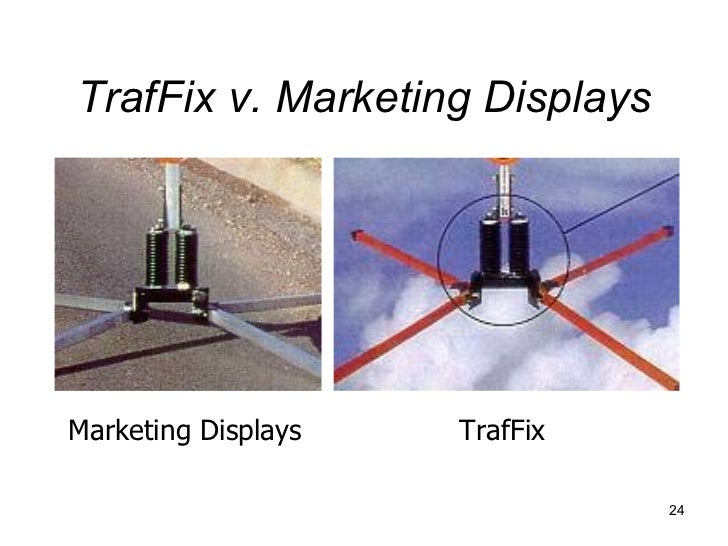
The plaintiff , Marketing Display, Inc., held patents (US 3662482 , US 3646696 ) for a two-spring design used to stabilize traffic signs in strong winds. Following the expiration of the plaintiff's patents, the defendant , TrafFix Devices, Inc., started producing their own signs utilizing the same design. The plaintiff filed a lawsuit, alleging trade dress infringement based on the imitation of the distinctive design. The central legal issue addressed by the courts was whether trade dress protection could be granted to a product that was previously covered by an expired patent.
Opinion of the Court
[(https://en.wikipedia.org/w/index.php?title=TrafFix_Devices,_Inc._v._Marketing_Displays,_Inc.&action=edit§ion=2 "Edit section: Opinion of the Court")
]
The Court, in a unanimous opinion by Justice Anthony Kennedy , held that there can be no trademark protection for something that is functional because that would work as a detriment to competitors based on something other than reputation, which is the key consideration in trademark law.
The Court noted that the plaintiff has the burden of proving that the characteristic for which protection is sought is not functional —but having a patent for a design raises a very strong presumption that the design was functional. A design is functional if it serves any purpose that makes the product work better, or makes the product less expensive to produce. That an alternative design is available does not undercut the functionality of a given design.
Discussing trademarks, we have said “ ‘[i]n general terms, a product feature is functional,’ and cannot serve as a trademark, ‘if it is essential to the use or purpose of the article or if it affects the cost or quality of the article.’ ”. Expanding upon the meaning of this phrase, we have observed that a functional feature is one the “exclusive use of [which] would put competitors at a significant non-reputation-related disadvantage.” . . . Where the design is functional under the Inwood formulation there is no need to proceed further to consider if there is a competitive necessity for the feature.
Here, Justice Kennedy said, the design was clearly functional, and the plaintiff could not carry the burden of proving otherwise because the very characteristic that is sought to be protected by trademark is the one whose functionality was previously sought to be covered by patent.
See also
[(https://en.wikipedia.org/w/index.php?title=TrafFix_Devices,_Inc._v._Marketing_Displays,_Inc.&action=edit§ion=3 "Edit section: See also")
]
References
[(https://en.wikipedia.org/w/index.php?title=TrafFix_Devices,_Inc._v._Marketing_Displays,_Inc.&action=edit§ion=4 "Edit section: References")
]
 _TrafFix Devices, Inc. v. Marketing Displays, Inc._,
 [U.S.](https://en.wikipedia.org/wiki/United_States_Reports "United States Reports")

 (2001).  _This article incorporates [public domain material from this U.S government document](https://en.wikipedia.org/wiki/Copyright_status_of_works_by_the_federal_government_of_the_United_States "Copyright status of works by the federal government of the United States")
._
External links
[(https://en.wikipedia.org/w/index.php?title=TrafFix_Devices,_Inc._v._Marketing_Displays,_Inc.&action=edit§ion=5 "Edit section: External links")
]
- Text of TrafFix Devices, Inc. v. Marketing Displays, Inc., U.S. 23 (2001) is available from: Cornell CourtListener Google Scholar Internet Archive (docket files) Justia Library of Congress Oyez (oral argument audio)
U.S. Supreme Court Article I case law
Commerce Clause of Section VIII
Coinage Clause of Section VIII
Copyright Clause of Section VIII
Retrieved from "https://en.wikipedia.org/w/index.php?title=TrafFix_Devices,_Inc._v._Marketing_Displays,_Inc.&oldid=1351329965 "
Hidden categories:
Search
Search
TrafFix Devices, Inc. v. Marketing Displays, Inc.
Add languages Add topic
This is legal information, not legal advice. Laws vary by jurisdiction and change frequently. Always verify current law with official sources and consult a licensed attorney in your jurisdiction for advice on your specific situation.