Environmental Protection Agency
Protects human health and the environment
Mission & Role
We owe you an explanation.
June 19: An important update for readers in the United States.
You deserve an explanation, so please don't skip this 1-minute read. It's Friday, June 19, and you only had a small chance of seeing our message. This year, Wikipedia has seen fewer visitors and fewer new supporters, so your visit today means a lot. We hope that Wikipedia has given you at least $2.75 of knowledge recently. If everyone who finds Wikipedia useful gave $2.75, we'd hit our goal in a few hours.
It's been 25 years and Wikipedia is still free. It's still created by people, not machines, and we don't run ads or put up paywalls because we're not here to make a profit off your attention. In other words, it's still the internet we were promised.
Less than 2% of our readers donate, so if you've never given and Wikipedia has provided you with at least $2.75 worth of knowledge, donate today. If you are undecided, remember any contribution helps.
Wikimedia Foundation
Proud host of Wikipedia and other free knowledge projects
How often would you like to donate?
- Once
- Monthly
- Yearly
Support Wikipedia year-round
Thanks for your generous support
Please select an amount (USD)
The average donation in the United States is around $13.
$2.75
$15
$25 Preferred Amount
$50
$100
$250
$500
Other amountOther
I'll generously add a little to cover the transaction fees so you can keep 100% of my donation.
Please select a payment method
 Online Banking
Credit / Debit CardVisaMastercardAmerican ExpressJCBDiscover
PayPal
Venmo
Apple Pay
Google Pay
ContinueDonate one timeDonate monthlyDonate yearly
Please select an amount (minimum $1)
We cannot accept donations greater than 25000 USD through our website. Please contact our major gifts staff at benefactors@wikimedia.org.
Please select a payment method
Maybe later
Can we follow up and let you know if we need your help again? The support and advice we get from donors in the United States is priceless, but many donors don't let us stay in touch. Will you commit today, this Friday, to staying in touch with the Wikimedia Foundation?
- Yes
- No
Sorry to hear that. We don't email often; would you consider changing your mind?
Thanks for changing your mind! We’ll respect your inbox.
Your information is handled in accordance with our donor privacy policy, and each email you receive will include easy unsubscribe options.
Continue
Please select an email option
Almost done: Please, make it monthly.
Monthly support is the best way to ensure that Wikipedia keeps thriving.
No thanks! I'll make a one-time donation of Yes, I'll donate each month
Yes, I'll donate monthly, but for a different amount
Thank you for your support!
Enter your monthly donation amount
Please select an amount (minimum $1)
We cannot accept donations greater than 25000 USD through our website. Please contact our major gifts staff at benefactors@wikimedia.org.
Donate monthly
|
|
Where your donation goes
|
|
I already donated
We never sell your information. By submitting, you are agreeing to our donor privacy policy and to sharing your information with the Wikimedia Foundation and its service providers in the USA and elsewhere. Donations to the Wikimedia Foundation are likely not tax-deductible outside the USA.We never sell your information. By submitting, you are agreeing to our donor privacy policy. The Wikimedia Foundation is a nonprofit, tax-exempt organization.We never sell your information. By submitting, you are agreeing to our donor privacy policy and to sharing your information with the Wikimedia Foundation and its service providers in the U.S. and elsewhere. The Wikimedia Foundation is a recognized public welfare institution (ANBI).If you make a recurring donation, you will be debited by the Wikimedia Foundation until you notify us to stop. We’ll send you an email which will include a link to easy cancellation instructions.
Sorry to interrupt, but we can't show this to everyone. In fact, only a small fraction will see it. Please, donate $2.75.
No, but maybe later when I have more timeYes, I'll donate $2.75
How would you like to be reminded?
Whether you give now or later, any contribution helps. We can send you an email or text message reminder to join the 2% of readers who donate.
Send me an emailSend me a text message
Send me an email reminder
We’ll gladly send you an email reminder and get out of your way so you can get back to reading.
Email addressSubmit
Please enter a valid email address i.e. name@domain.com
We never sell your information. By submitting, you are agreeing to our donor privacy policy. The Wikimedia F
…
History
History
[ edit]
Background
[ edit]
 Stacks emitting smoke from burning discarded automobile batteries, photo taken in Houston in 1972 by Marc St. Gil, official photographer of recently founded EPA
 Same smokestacks in 1975 after the plant was closed in a push for greater environmental protection
Beginning in the late 1950s and through the 1960s, the US Congress reacted to increasing public concern about the impact that human activity could have on the environment.[6][7][8] Senator James E. Murray introduced a bill, the Resources and Conservation Act (RCA) of 1959, in the 86th Congress. The bill would have established a Council on Environmental Quality in the Executive Office of the President, declared a national environmental policy, and required the preparation of an annual environmental report. The conservation movement was weak at the time and the bill did not pass Congress.[9]
The 1962 publication of Silent Spring, a best-selling book by Rachel Carson, alerted the public about the detrimental effects on animals and humans of the indiscriminate use of pesticide chemicals.[10]
In the years following, Congress discussed possible solutions. In 1968, a joint House–Senate colloquium was convened by the chairmen of the Senate Committee on Interior and Insular Affairs, Senator Henry M. Jackson, and the House Committee on Science and Astronautics, Representative George P. Miller, to discuss the need for and means of implementing a national environmental policy. Congress enacted the National Environmental Policy Act of 1969 (NEPA) and the law was based on ideas that had been discussed in the 1959 and subsequent hearings.[11][9]
The Richard Nixon administration made the environment a policy priority in 1969–1971 and created two new agencies, the Council on Environmental Quality (CEQ) and EPA.[12] Nixon signed NEPA into law on January 1, 1970. The law established the CEQ in the Executive Office of the President. NEPA required that a detailed statement of environmental impacts be prepared for all major federal actions significantly affecting the environment. The "detailed statement" would ultimately be referred to as an environmental impact statement (EIS).[6]
Establishment
[ edit]
[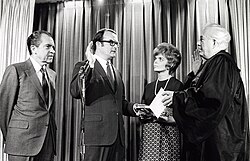 ](https://en.wikipedia.org/wiki/File:William_Ruckelshaus_Swear
…
Programs & Activities
Programs
[ edit]
.jpg) EPA scientists conducting a stream survey on the Merrimack River in Massachusetts
EPA scientists conducting a stream survey on the Merrimack River in Massachusetts
EPA established its major programs pursuant to the primary missions originally articulated in the laws passed by Congress. Additional programs have been developed to interpret the primary missions. Some of the newer programs have been specifically authorized by Congress.[143] Former administrator William Ruckelshaus observed in 2016 that a danger for EPA was that air, water, waste and other programs would be unconnected, placed in "silos", a problem that persists more than 50 years later, albeit less so than at the start.[144]
Core programs
[ edit]
Air quality and radiation protection
[ edit]
The Office of Air and Radiation (OAR) describes itself as the official authority in charge of "developing national programs, policies, and regulations for controlling air pollution and radiation exposure." The OAR is responsible for enforcing the Clean Air Act, the Atomic Energy Act, the Waste Isolation Pilot Plant Land Withdrawal Act, and other applicable laws. The OAR is in charge of the Offices of Air Quality Planning and Standards, Atmospheric Protection, Transportation and Air Quality, and the Office of Radiation and Indoor Air.[125]
Ambient standards
[ edit]
- National Ambient Air Quality Standards (NAAQS)
- State Implementation Plans (SIPs)
Stationary air pollution source standards
[ edit]
- New Source Performance Standards
- National Emissions Standards for Hazardous Air Pollutants (NESHAPs)
- Permits for industrial and commercial sources
Mobile source standards
[ edit]
 Testing automobile emissions at an EPA laboratory in Ann Arbor, Michigan
- On-road vehicles regulation
- Non-road vehicle regulation (including aircraft, locomotives, marine transport, stationary engines)
- Transportation fuel controls
- National Vehicle Fuel and Emissions Laboratory (NVFEL)
Radiation protection
[ edit]
The Radiation Protection Program comprises seven project groups.[145]
- Radioactive Waste[146]
- Emergency Preparedness and Response Programs[147] Protective Action Guides And
…
Agency overview, history, and program data sourced from Wikipedia (CC-BY-SA 3.0).
Recent Federal Register documents from EPA
See more- Proposed RuleOct 6, 2026· Environmental Protection AgencyInitial Air Quality Designations for the 2024 Revised Primary Annual Fine Particle (PM2.5) National Ambient Air Quality Standards (NAAQS)
- NoticeOct 6, 2026· Environmental Protection AgencyCertain New Chemicals or Significant New Uses; Statements of Findings-June 2026
- NoticeOct 6, 2026· Environmental Protection AgencyPhasedown of Hydrofluorocarbons: Notice of 2027 Allowance Allocations for Production and Consumption of Regulated Substances Under the American Innovation and Manufacturing Act of 2020, and Notice of Final Actions Establishing Administrative Consequences
- NoticeOct 2, 2026· Environmental Protection AgencyEnvironmental Impact Statements; Notice of Availability
- RuleOct 2, 2026· Environmental Protection AgencyPhosphatidylcholine in Pesticide Formulations; Exemption From the Requirement for a Tolerance
- RuleOct 1, 2026· Environmental Protection AgencyAttainment Date Extension for the South Coast, California 2012 Annual PM2.5 Fine Particulate Matter Nonattainment Area
- RuleOct 1, 2026· Environmental Protection AgencyAir Plan Approval; Missouri; Control of NOX Emissions From Large Stationary Internal Combustion Engines
- RuleOct 1, 2026· Environmental Protection AgencyAdministration of Cross-State Air Pollution Rule Trading Program Assurance Provisions for 2025 Control Period
Key Regulations
National Ambient Air Quality Standards (NAAQS)
Sets limits on six common air pollutants to protect public health and the environment.
NPDES Permit Program for Water Discharge
Requires permits for any discharge of pollutants into navigable waters and sets effluent limitations.
Identification and Listing of Hazardous Waste
Defines what counts as hazardous waste and establishes cradle-to-grave management requirements.
National Oil and Hazardous Substances Pollution Contingency Plan
Establishes procedures for responding to hazardous substance releases and cleaning up Superfund sites.
National Primary Drinking Water Regulations
Sets enforceable standards for drinking water quality including maximum contaminant levels.
Premanufacture Notification for New Chemical Substances
Requires manufacturers to notify EPA before producing new chemicals and allows EPA to restrict unsafe chemicals.
Mandatory Greenhouse Gas Reporting
Requires large emitters to report their greenhouse gas emissions annually to EPA.
Hazardous Chemical Reporting: Community Right-to-Know
Requires facilities to report hazardous chemicals to local emergency planners and the public.
National Environmental Policy Act Implementation (CEQ Regulations)
Requires federal agencies to assess environmental impacts before undertaking major projects or decisions.
Enforcement Actions
EPA v. Volkswagen — Clean Air Act Violations (Dieselgate)
Respondent: Volkswagen AG
The EPA, working with the Department of Justice and the California Air Resources Board, reached a landmark settlement with Volkswagen over the company's use of defeat devices in approximately 590,000 ...
Outcome: $14.7 billion total settlement; vehicle buybacks; criminal guilty pleas by company and executives.
EPA v. Duke Energy — Coal Ash Contamination
Respondent: Duke Energy
Duke Energy pleaded guilty to nine criminal violations of the Clean Water Act related to the illegal discharge of coal ash pollutants from five power plants in North Carolina. The case was initiated f...
Outcome: Criminal guilty plea; $102M in penalties and environmental projects; mandatory excavation.
EPA v. BP — Deepwater Horizon Oil Spill
Respondent: BP Exploration & Production Inc.
BP agreed to a $20.8 billion settlement with the federal government and five Gulf Coast states to resolve claims arising from the 2010 Deepwater Horizon oil spill, the largest environmental disaster i...
Outcome: $20.8B civil settlement; $4.5B criminal penalties; criminal guilty plea; regulatory reforms.
EPA v. Pacific Gas & Electric — Hinkley Groundwater Contamination
Respondent: Pacific Gas and Electric Company
Pacific Gas and Electric Company agreed to pay $333 million to settle claims that it contaminated groundwater in Hinkley, California with hexavalent chromium (chromium-6) from its natural gas compress...
Outcome: $333M settlement to affected residents; ongoing groundwater remediation required.
EPA v. DuPont — PFAS Contamination (GenX)
Respondent: The Chemours Company (DuPont spin-off)
The EPA reached a consent order with Chemours (a DuPont spin-off) related to PFAS contamination from its Fayetteville Works facility in North Carolina. The facility had been discharging GenX and other...
Outcome: $50M penalty; pollution controls required; environmental monitoring mandate.
EPA v. Freedom Industries — Elk River Chemical Spill
Respondent: Freedom Industries, Inc.
Freedom Industries was responsible for one of the most significant water contamination events in recent American history when approximately 10,000 gallons of crude MCHM (4-methylcyclohexanemethanol), ...
Outcome: Criminal prosecution; bankruptcy; led to state chemical storage regulations.
EPA v. Harley-Davidson — Clean Air Act Violations
Respondent: Harley-Davidson, Inc.
Harley-Davidson agreed to pay $15 million in penalties and stop selling aftermarket devices known as 'super tuners' that, when installed, caused motorcycles to emit air pollutants at levels exceeding ...
Outcome: $15M penalty; ceased sales of super tuners; buyback and destruction of inventory.